

Cognitive Bias Modification for Memory Bias (CBM-M) May Help Reduce Stress
Summary
The study provides the first evidence that memory-based training reduces stress and alters its underlying neurobiological mechanisms
Negative memory bias, the tendency to remember negative experiences more easily than positive ones, can fuel cycles of anxiety and depression. In a recent study, researchers from the University of Toyama identified Cognitive bias modification for memory bias (CBM-M) as a potential, accessible intervention for people at risk. Using a randomized controlled trial and brain imaging techniques, the study shows that CBM-M can reduce psychological and biological stress and alter brain circuits linked to emotional memory.
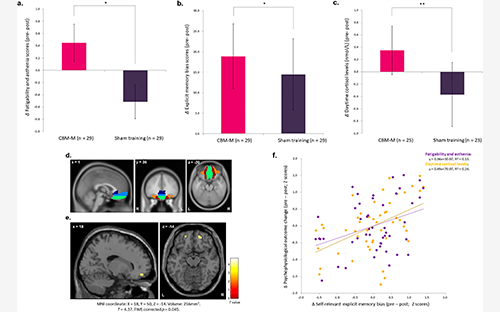
- Image title: Effects of cognitive bias modification for memory (CBM-M) compared with sham training
- Image caption: Compared with sham training, CBM-M specifically lowered cortisol levels and stress vulnerability, whose magnitudes were correlated with reduced negative memory bias. Brain scans showed it also strengthened connectivity between the amygdala and the anteromedial orbitofrontal cortex, suggesting a neural mechanism for its benefits.
- Credit:Professor Yuko Hakamata from the University of Toyama, Japan
- License type:CC BY-NC-ND 4.0
- Usage restrictions:Credit must be given to the creator. Only noncommercial uses of the work are permitted. No derivatives or adaptations of the work are permitted.
Research Details
Cognitive Bias Modification for Memory Bias (CBM-M) May Help Reduce Stress[PDF, 297KB]
Reference
Title of original paper
The effectiveness and neurobiological actions of memory bias modification: a randomized controlled trial
Journal
Psychological Medicine
DOI
https://doi.org/10.1017/S0033291725102535
Additional information for EurekAlert
Latest Article Publication Date
24 December 2025
Method of Research
Randomised controlled/clinical trial
Subject of Research
People
Conflicts of Interest Statement
The authors declare none.
Media contact
Yumiko Kato
E-mail: 