

Nash Equilibria: The Hidden Math Behind Predator–Prey Behaviors
Summary
Using game theory, researchers show how attack and defense strategies emerge as stable behavioral dynamics
Animal survival depends on effective attack and defense strategies, yet how these behaviors arise remains unclear. Addressing this question, a recent study shows that predator and prey behaviors emerge naturally as stable patterns shaped by simple sensory abilities and motor rules. These patterns correspond to Nash equilibria—states in which neither predator nor prey can improve its outcome by unilaterally changing behavior—providing a theoretical framework for understanding predator–prey interactions.
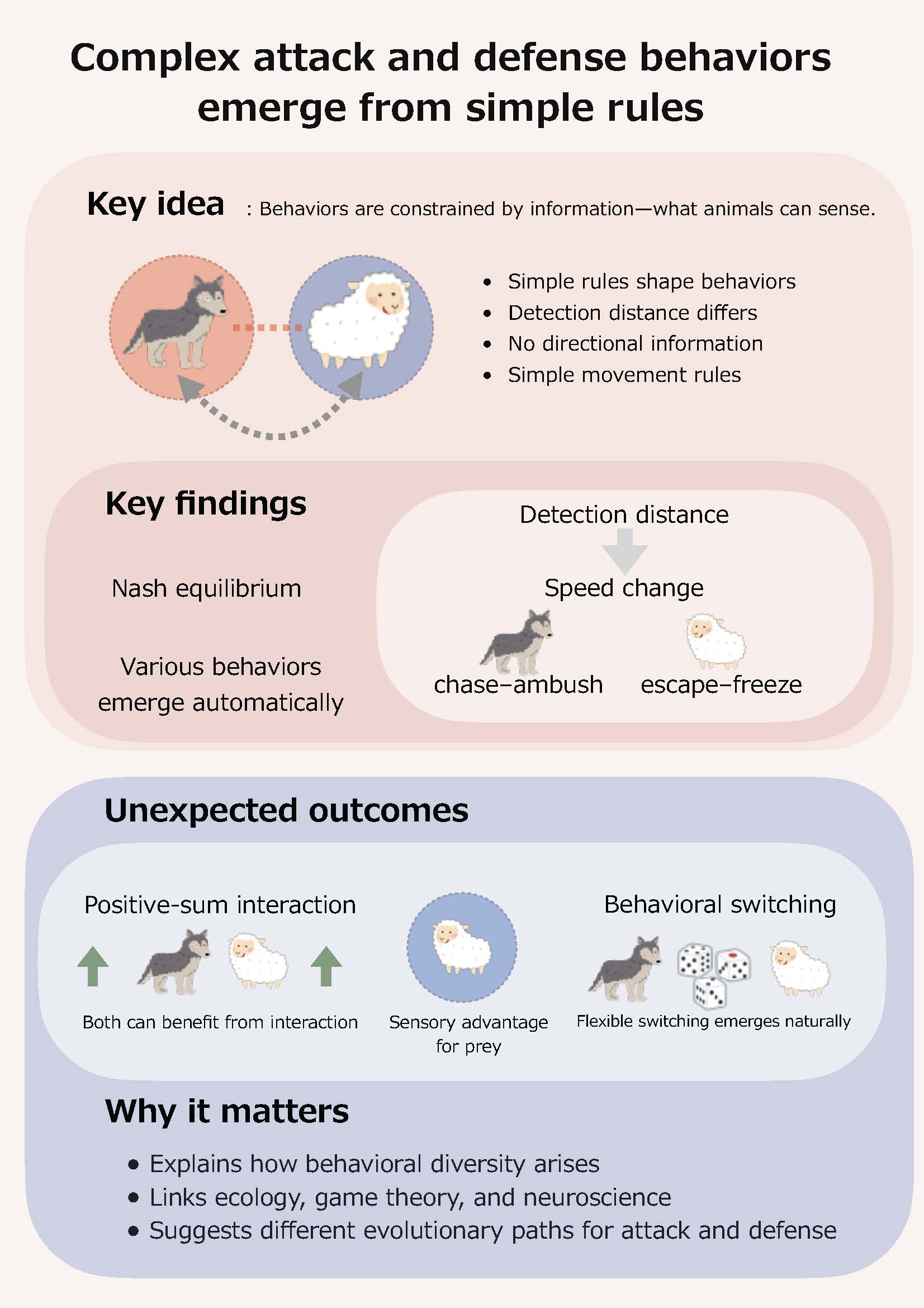
- Image title: How Simple Sensing and Movement Rules Generate Diverse and Stable Predator–Prey Behaviors
- Image caption:Researchers used computational simulations to demonstrate how simple sensing and movement rules—such as detection of distance and speed changes—constrain predator–prey interactions. In a simplified model, detection alone (without directional information) triggers movement responses, producing chasing, ambush, escape, or freezing behaviors. Varying sensory ranges and movement rules lead to predictable, stable attack and defense strategies consistent with Nash equilibrium, while also allowing flexible behavioral switching and sensory advantages to emerge naturally.
- Credit:Professor Hiroyuki Ichijo from the University of Toyama, Japan
- License type:Original content
- Usage restrictions:Credit must be given to the creator.
Research Details
Nash Equilibria: The Hidden Math Behind Predator–Prey Behaviors[PDF, 510KB]
Reference
Title of original paper
Nash equilibrium of attack and defense behaviors between predators and prey
Journal
PLOS Computational Biology
DOI
https://doi.org/10.1371/journal.pcbi.1013730
Additional information for EurekAlert
Latest Article Publication Date
21 November 2025
Method of Research
Computational simulation/modelling
Subject of Research
Animals
Conflicts of Interest Statement
The authors have declared that no competing interests exist.
Media contact
Yumiko Kato
E-mail: 