

Large-Scale Crystals Could Revolutionize Future OLED Displays
Summary
Crystalline organic semiconductors offer excellent charge transport but have been difficult to incorporate into practical OLEDs. Researchers from the University of Toyama developed the first OLED using a non-epitaxial crystalline rubrene thin film. Using a two-step annealing process, they achieved 1,000-fold higher current density and a turn-on voltage of just 1.33 V. This breakthrough demonstrates that crystalline organic semiconductors can be integrated into practical OLEDs, paving the way for a “crystalline generation” of displays.
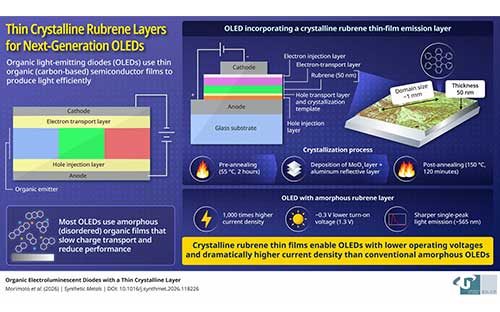
- Image title: OLED with a non-epitaxial crystalline rubrene thin film
- Image caption: A two-step annealing process transformed amorphous rubrene into a crystalline thin film, enabling OLEDs with up to 1,000 times higher current density, lower turn-on voltage, and a sharp single emission peak.
- Credit: Professor Masahiro Morimoto from the University of Toyama, Japan
- License type: Original content
- Usage restrictions: Cannot be reused without permission.
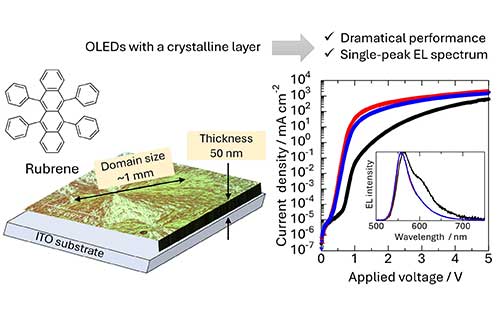
- Image title: Crystalline rubrene thin films enable brighter, lower-voltage OLEDs
- Image caption: The crystalline rubrene thin film forms large orthorhombic crystal domains up to 1 mm across, providing efficient charge transport, high current density, low turn-on voltage, and a sharp single-emission peak.
- Credit: Professor Masahiro Morimoto from the University of Toyama, Japan
- License type: Original content
- Usage restrictions: Cannot be reused without permission.
Research Details
Large-Scale Crystals Could Revolutionize Future OLED Displays[PDF, 748KB]
Reference
Title of original paper
Organic electroluminescent diodes with a thin crystalline layer
Journal
Synthetic Metals
DOI
https://doi.org/10.1016/j.synthmet.2026.118226
Additional information for EurekAlert
Latest Article Publication Date
1 August 2026
Method of Research
Experimental study
Subject of Research
Not Applicable
Conflicts of Interest Statement
The authors declare that they have no known competing financial interests or personal relationships that could have appeared to influence the work reported in this paper.
Media contact
Yumiko Kato
E-mail: 