

Just 50°C Decides Whether an Ultrathin Magnetic Film Stays Flat or Falls Apart
Summary
A two-step heating process produces highly ordered 5-nm-thick FePd films for low-power magnetic random-access memory and high-density magnetic storage
Ultrathin magnetic films for next-generation memory devices face a trade-off between atomic ordering and surface flatness. Researchers from the University of Toyama addressed this using a two-step heating method to grow highly ordered 5-nm-thick FePd films. The process involves low-temperature deposition for smooth layer-by-layer growth, followed by an annealing step to promote atomic ordering. The findings provide a simple strategy for developing energy-efficient magnetic random-access memory and high-density magnetic storage technologies.
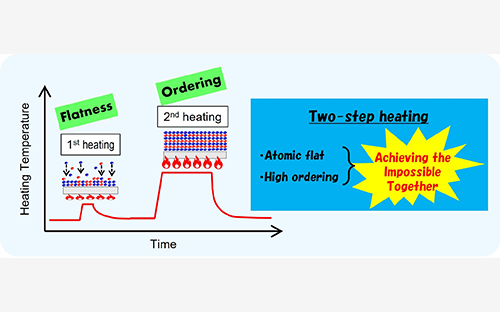
- Image title: Two-step heating method delivers flat, highly ordered ultrathin magnetic films
- Image caption: The researchers fabricated 5-nm-thick L10-FePd films using a two-step heating process: low-temperature deposition for smooth layer-by-layer growth, followed by 600°C annealing to promote atomic ordering.
- Credit:Professor Hiroshi Naganuma from the University of Toyama, Japan
- License type:Original content
- Usage restrictions:Cannot be reused without permission
Research Details
Just 50°C Decides Whether an Ultrathin Magnetic Film Stays Flat or Falls Apart[PDF, 438KB]
Reference
Title of original paper
Harnessing Two-Step Heating and Solid-State Dewetting for Highly Ordered L10-FePd Alloy Epitaxial Films
Journal
Journal of Alloys and Compounds
DOI
https://doi.org/10.1016/j.jallcom.2026.189751
Additional information for EurekAlert
Latest Article Publication Date
26 July 2026
Method of Research
Experimental study
Subject of Research
Not Applicable
Conflicts of Interest Statement
The authors declare the following financial interests/personal relationships which may be considered as potential competing interests. Hiroshi Naganuma reports financial support was provided by Nagoya University. Hiroshi Naganuma reports a relationship with Nagoya University that includes: employment. If there are other authors, they declare that they have no known competing financial interests or personal relationships that could have appeared to influence the work reported in this paper.
Media contact
Yumiko Kato
E-mail: 