

Household-Specific Indoor Particulate Matter Associated with Kawasaki Disease Onset in Children
Summary
The study examined household-specific fine and coarse particulate matter exposure during early childhood and its association with Kawasaki disease onset
Researchers in Japan investigated the association between household-specific indoor particulate matter exposure and Kawasaki disease onset by age 6. The study included 3,846 mother–child pairs from the Japan Environment and Children’s Study. Higher coarse particulate matter concentrations were associated with lower odds of Kawasaki disease, whereas fine particulate matter showed a weaker, statistically nonsignificant association. The research may inform future investigations into the relationship between indoor environmental exposures and Kawasaki disease in children.
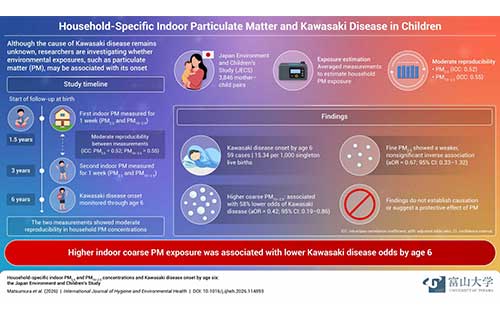
- Image title: Assessing Indoor Particle Exposure in Relation to Kawasaki Disease
- Image caption: Researchers estimated household-specific particulate matter exposure and tracked Kawasaki disease onset from birth through age 6.
- Credit:Professor Kenta Matsumura from University of Toyama, Japan
- License type:Original content
- Usage restrictions:Cannot be reused without permission.
Research Details
Reference
Title of original paper
Household-specific indoor PM2.5 and PM10–2.5 concentrations and Kawasaki disease onset by age six: the Japan Environment and Childrenʼs Study
Journal
International Journal of Hygiene and Environmental Health
DOI
https://doi.org/10.1016/j.ijheh.2026.114893
Additional information for EurekAlert
Latest Article Publication Date
11 September 2026
Method of Research
Observational study
Subject of Research
People
Conflicts of Interest Statement
NA
Media contact
Azusa Matsuda
E-mail: 