

Mapping the Risk Factors for Mother-Infant Bonding Disorder
-University of Toyama researchers find three factors that predict mother-to-infant bonding difficulties in the absence of postnatal depression-
Summary
Mother-to-infant bonding difficulties (MIBD) are commonly associated with postnatal depression. MIBD has been linked to developmental delays and child abuse. Researchers found that about half of MIBD cases in Japan involve mothers who did not experience postpartum depression. Difficulty holding a fussy baby, lack of happiness about pregnancy, and low social support predict an increased risk of MIBD. Clinicians observing these signs should intervene to ensure maternal and child well-being.
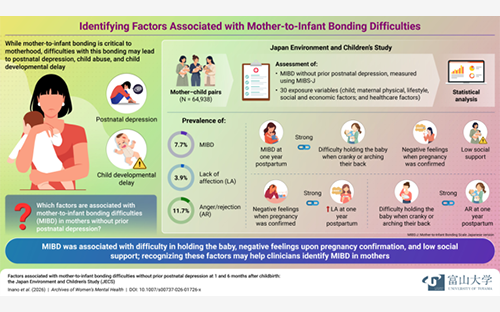
- Image title: Identifying Factors Associated with Mother-to-Infant Bonding Difficulties
- Image caption: About half of all cases of mother-to-infant bonding difficulties (MIBD) occur among mothers who do not experience postnatal depression. Difficulty holding a fussing baby, lack of positive emotions about pregnancy, and low social support during pregnancy and postpartum are strong predictors of MIBD. MIBD has been linked to developmental delays and child abuse.
- Credit: Ms. Hitomi Inano from the University of Toyama
- License type: Original content
- Usage restrictions: You are free to share and adapt the Infographic material but attribution is required, with a link to the news source.
Research Details
Mapping the Risk Factors for Mother-Infant Bonding Disorder[PDF, 524KB]
Reference
Title of original paper
Factors associated with mother-to-infant bonding difficulties without prior postnatal depression at 1 and 6 months after childbirth: the Japan Environment and Children’s Study (JECS)
Journal
Archives of Women’s Mental Health
DOI
https://doi.org/10.1007/s00737-026-01726-x
Additional information for EurekAlert
Latest Article Publication Date
3 June 2026
Method of Research
Observational study
Subject of Research
People
Conflicts of Interest Statement
The authors declare no competing interests.
Media contact
Ms. Hitomi Inano
E-mail: 